

Square vs. Round Light Poles: Which Size and Shape Fit Your Project?
When you compare square and round light poles, both options can look suitable on a product page, and you may still wonder, “What size light pole do I need?” The right choice becomes clearer when you compare mounting height, fixture layout, wind conditions, and the structure required to support the load.
Square vs. round light pole selection is not about picking a shape that looks better. Square poles often suit multi-fixture parking lots and industrial areas, while round poles can fit taller installations where wind exposure becomes a larger part of the design decision.
Choose a square pole when you need flat mounting faces for arms or multiple fixtures. Choose a round pole when a taller, lower-drag shaft better fits the fixture load, design wind speed, and project layout.
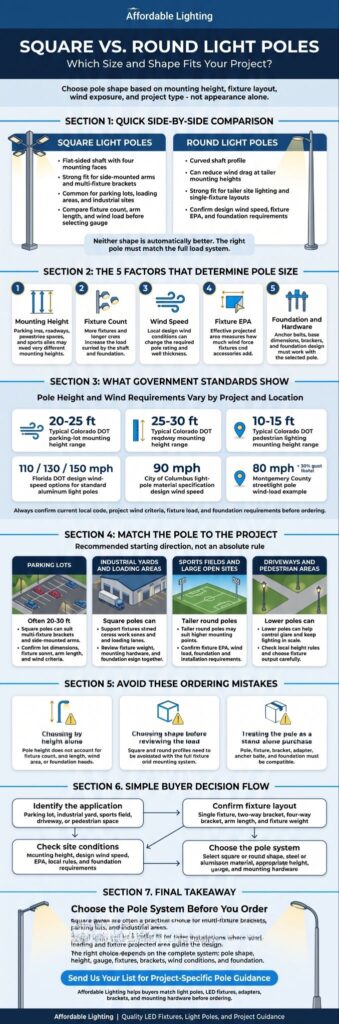
Quick Comparison: Square vs. Round Light Poles
Square and round poles can both support commercial LED fixtures, but shape affects mounting options, wind exposure, and the pole specifications your project may require.
| Selection Factor | Square Light Pole | Round Light Pole |
| Shaft profile | Flat sides and corners | Curved, continuous profile |
| Mounting flexibility | Useful for side-mounted arms and multi-direction brackets | Common for top-mounted or single-fixture arrangements |
| Wind exposure | Flat faces can present more area to wind. | Curved surfaces can reduce drag. |
| Typical project fit | Parking lots, loading areas, and industrial sites | Taller site lighting, roadway-style layouts, and single-fixture locations |
| Buyer focus | Bracket configuration, fixture count, and arm placement | Pole height, wind loading, and fixture effective projected area |
How Affordable Lighting Approaches Square Pole Sizing
Square poles can provide a practical mounting surface when your layout needs fixtures aimed in several directions. Confirm the fixture count, arm length, fixture weight, and projected wind area before selecting the shaft size or gauge.
Affordable Lighting is a family-founded LED lighting supply business established in 1999, operating for over 25 years. The business sells LED fixtures, light poles, adapters, and project-based outdoor lighting solutions for parking lots, industrial buildings, sports fields, and public spaces.
Structural Rigidity for Mounted Arms and Multiple Fixture Heads
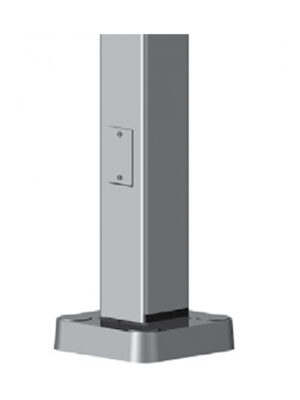
Square poles have four flat shaft faces. That layout can simplify mounting for two-way and four-way brackets because the hardware can sit against a flat surface instead of following a curved shaft.
Use this shape when your fixture layout requires lights to point in more than one direction. A parking lot entrance, loading area, or wide drive aisle may need multiple fixtures on the same pole, and the fixture count affects the total load the pole and foundation must support.
The New York State Office of General Services lighting-pole specification requires project documents to account for the pole, arm, luminaire, accessory loads, foundation details, anchor bolts, and wind-load calculations.
The specification also calls for signed and sealed foundation calculations by a professional engineer licensed in the installation state.
Sizing Considerations for Steel vs. Aluminum Square Poles
Steel and aluminum poles each suit different project conditions. Steel can support higher loads within a given shaft design, while aluminum can reduce pole weight and provide corrosion resistance.
Material alone does not determine the right pole size. You still need to match the shaft, arm, fixture, and foundation to the project wind condition.
The U.S. Department of Veterans Affairs pole specification requires pole and arm assemblies to account for the wind loading at the project site, plus the effective projected area of luminaires and accessories such as shields and banner arms.
Best-Fit Height Ranges by Pole Gauge
Do not select a pole gauge from height alone. A 20-foot parking lot pole with one fixture presents a different structural demand than a 20-foot pole carrying a long arm, multiple fixtures, or additional accessories.
The Colorado DOT Lighting Design Guidelines lists typical mounting heights of 20 to 25 feet for parking lots, 25 to 30 feet for roadways, and 10 to 15 feet for pedestrian areas. Those ranges guide layout planning, but the final pole specification still needs to account for fixture load and wind conditions.
What Round Poles Offer
Round poles offer a curved shaft profile that can be a strong fit for taller fixture mounting heights. Their curved profile can affect wind loading compared with a shaft with flat faces.
Every pole Affordable Lighting lists is tested by an in-house team of skilled professionals before being listed for sale.
Lower Wind Resistance for Taller Pole Runs
Wind loading is a design requirement, not a detail to resolve after ordering. The Florida Department of Transportation Traffic and ITS Design Manual states that standard aluminum light poles are designed for 110, 130, or 150 mph design wind speeds, and its pole standards also address foundations for conventional roadway lighting poles.
For taller installations, ask for a pole specification that matches the site’s design wind speed, fixture effective projected area, bracket or arm arrangement, and foundation condition.
A round shaft may be a practical choice when those factors favor a taller, lower-drag configuration, but shape does not replace a proper wind-load review.
The Key Differences That Matter for Sizing
Pole shape matters, but it is only one part of a complete sizing decision. You need to evaluate pole height, fixture load, mounting hardware, site wind conditions, and foundation requirements as one system.
Wind Load and Gauge: How Shape Changes Required Thickness
A pole design must handle wind acting on the shaft and everything attached to it. That includes luminaires, brackets, arms, banners, and other accessories.
The City of Columbus light-pole material specification states that lighting poles below 70 feet must meet AASHTO design requirements and use a 90 mph design wind speed in their material specification.
Montgomery County, Maryland, requires a streetlight pole to withstand calculated wind loads based on at least an 80 mph wind with a 30 percent gust factor. Its specification also requires the pole to support up to 2.0 effective projected area under those conditions.
These public specifications show why two poles with the same height may need different shaft thicknesses or foundation details. A square or round option should be selected only after checking the complete load combination.
Matching Pole Shape and Size to Your Specific Project Type
Most pole comparisons stop after saying that square poles suit multi-fixture layouts and round poles suit taller installations. The more useful question is which shape-and-size combination fits the application you are buying for.
Use the following decision framework before ordering:
- Parking lot: A 20 to 30-foot pole may fit many layouts. Square poles often work well when fixtures need side-mounted arms or multiple directions. Confirm lot dimensions, target light levels, fixture count, arm length, and local wind criteria.
- Industrial yard or loading area: Consider square poles when fixture heads must aim across loading lanes, equipment areas, or wide work zones. Review fixture count and arm configuration before selecting the shaft and foundation.
- Sports field or large open site: Taller round poles may fit the lighting layout when fixtures need a higher mounting point. Confirm wind loading, fixture effective projected area, foundation design, and installation requirements before purchase.
- Driveway or pedestrian area: Lower poles can reduce glare and maintain a more appropriate scale. Confirm local requirements before selecting height, shape, and fixture output.
The City of Cold Spring, New York, provides an example of why application matters: its outdoor-lighting rules limit many parking-lot fixtures to 17 feet above grade, permit up to 30 feet in industrial areas under stated conditions, and limit freestanding luminaires in residential zones to 12 feet.
Which Pole Is Best for Your Project?
Square poles can suit buyers who need flat-sided mounting for multi-fixture brackets, side arms, parking lots, loading zones, and industrial work areas.
Round poles are best for buyers planning taller installations where wind loading, fixture projected area, and a lower-drag shaft profile guide the decision.
Neither shape is automatically better for every project. A 20-foot parking lot pole, a 30-foot industrial pole, and a 40-foot sports-lighting pole all require different checks before you match the pole to the fixture and foundation.
Frequently Asked Questions
Q1. What size light pole do I need for a parking lot?
A parking lot often uses 20 to 30-foot mounting heights, but the correct pole size depends on the lot layout, fixture count, fixture output, arm length, wind criteria, and foundation design.
The Colorado DOT Lighting Design Guidelines lists 20 to 25 feet as a typical parking-lot mounting-height range, but your final pole selection must match the full fixture and site load.
Q2. Is a square or round light pole better for wind resistance?
A round shaft can affect wind loading because of its curved surface. However, wind resistance also depends on pole height, shaft dimensions, fixture effective projected area, arm length, local design wind speed, and foundation capacity. Select the pole only after reviewing all of those conditions together.
Q3. Can I mount multiple fixtures on one light pole?
Yes. A square pole can be a practical option for multi-fixture brackets because its flat sides simplify side-mounted hardware. The pole and foundation must still support the combined fixture weight and wind area, so verify the selected bracket, fixtures, and pole rating before ordering.
Q4. What is the difference between steel and aluminum light poles?
Steel and aluminum differ in weight, corrosion resistance, and structural design options. Steel can suit heavier loading conditions, while aluminum can offer lower weight and corrosion resistance.
The right material still depends on the required pole rating, fixtures, wind conditions, finish requirements, and installation environment.
Q5. How do I choose the right round or square light pole size?
The right round or square light pole size depends on your mounting height, fixture type, fixture count, arm or bracket setup, local wind conditions, and foundation requirements.
Share those details before ordering so the pole, fixtures, adapters, and mounting hardware can be evaluated as a complete system.
Choose the Pole Before You Order
A pole is not a stand-alone purchase. The shaft shape, height, gauge, fixture load, mounting hardware, wind conditions, and foundation all need to work together.
If you need help selecting a pole or have a question about “what size light pole do I need,” send Affordable Lighting your project list with the fixture count, mounting height, application, and site details. Affordable Lighting can help you identify compatible poles, fixtures, adapters, and mounting hardware before you place your order.
About author


Add comment