

20-Foot Aluminum Light Pole vs. Steel: Which Lasts Longer for Your Project
When you compare a 20-foot aluminum light pole with a steel option, you get dozens of answers that all sound confident, and few of them agree with each other. Some pages call aluminum the obvious winner. Others insist steel is the only serious choice for a commercial project.
If you are not sure which material actually fits your parking lot, sports field, or industrial site, this guide gives you a straight answer.
Affordable Lighting offers aluminum and steel pole options, allowing you to compare both materials for your project. So this comparison will not push you toward one material over the other. The goal is to match the pole to your project’s wind zone, fixture load, and maintenance plan.
Aluminum poles cost less to maintain and resist corrosion, while steel poles handle higher wind loads at the same wall thickness. The right choice depends on your site’s wind zone and environment.
Quick Comparison: Aluminum vs. Steel Light Poles
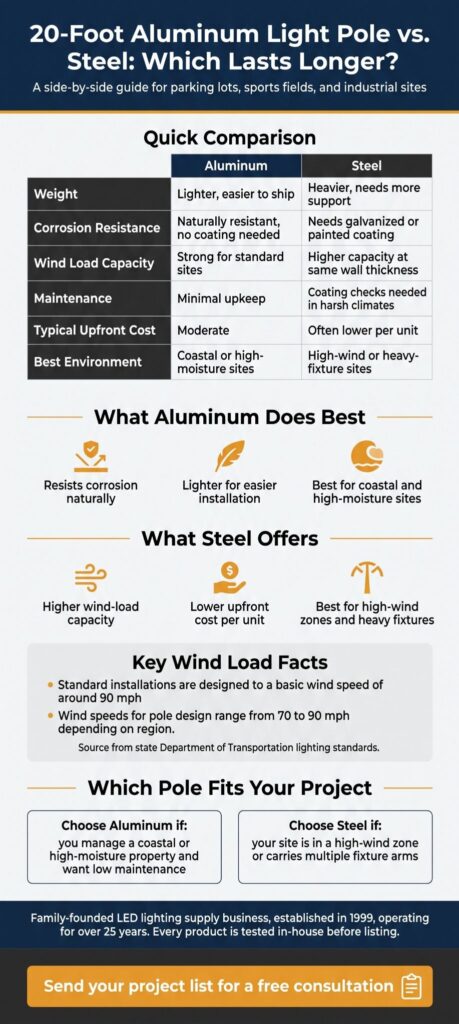
A 20-foot aluminum light pole and a steel pole both meet commercial lighting requirements, but they differ most in weight, wind rating, and long-term maintenance.
| Factor | Aluminum Pole | Steel Pole |
| Weight | Lighter, easier to ship and install | Heavier, needs more support during setup |
| Corrosion resistance | Naturally resistant, no coating required | Needs a galvanized or painted coating |
| Wind load capacity | Strong for standard commercial sites | Higher capacity at the same wall thickness |
| Maintenance | Minimal upkeep over the pole’s life | Coating checks needed in harsh climates |
| Typical upfront cost | Moderate | Often lower per unit |
| Best environment | Coastal or high-moisture sites | High-wind or heavy-fixture sites |
What the 20-Foot Aluminum Light Pole Does Best
Aluminum performs well when corrosion resistance and low maintenance matter more than maximum wind load capacity.
1. Corrosion Resistance and Low Maintenance
A 20-foot aluminum light pole does not rust the way steel can. Aluminum forms a natural oxide layer that protects it from moisture and salt air without any added coating.
You generally will not need to repaint or recoat the pole after years outdoors. This makes aluminum a reliable fit for coastal properties, parking structures near water, and sites with heavy irrigation runoff.
All products are tested by an in-house team of skilled professionals before being listed for sale, and that includes every aluminum pole in this lineup.
2. Lighter Weight for Easier Installation and Freight
Aluminum weighs less than steel at the same 20-foot height, which can lower freight costs and reduce the equipment needed for installation. A lighter pole also places less strain on the foundation, which can simplify permitting on sites with soil limitations.
3. Best-Fit Environments for Aluminum Poles
Choose aluminum when your project sits in a coastal zone, near a pool or irrigation system, or in a climate with frequent rain. Engineers typically calculate pole wind loads using the AASHTO wind load method, with a basic wind speed of 90 mph used for standard installations.
Confirm your local wind speed rating before you order so you specify your aluminum pole correctly for your site.
What 20-Foot Steel Poles Offer
Steel performs best when your site needs maximum wind resistance or supports heavier fixtures and mounting arms.
Higher Wind-Load Capacity at a Comparable Wall Thickness
Steel can carry more structural load than aluminum at the same wall thickness, which makes it a common choice for high-wind applications.
According to the New York State Department of Transportation’s lighting standard specifications, design wind speeds for pole structures range from 70 to 90 mph depending on the county.
The Texas Department of Transportation’s lighting pole specification requires an 11-gauge steel shaft with sealed wind load calculations, showing how closely gauge and wind rating are tied together.
A steel 20-foot pole can provide a wider margin when your site sits in a higher wind category or carries multiple fixture arms.
Upfront Cost and Availability Considerations
Steel poles often carry a lower per-unit cost than aluminum at the same height, which matters on large multi-pole projects with a fixed spending plan. Steel also ships in more gauge and finish options for projects that need a specific coating or thickness.
The Key Differences That Matter
The right material depends on your site’s wind zone, environment, and fixture load, not on which material performs better overall.
Wind Load and Mounting Compatibility
A 20-foot aluminum light pole and a steel pole can both meet standard commercial wind ratings, but the margin changes with height, fixture weight, and mounting arm count.
The Federal Highway Administration’s guidelines for sign, signal, and luminaire structures confirm that added fixtures raise fatigue and gust-load demands, so a pole with two or three fixture heads needs a higher design wind speed than a single-head installation, regardless of material.
Matching Pole Material to Your Site’s Wind Zone
Most comparison guides stop at “aluminum resists corrosion, steel resists wind” and leave you to guess which one applies to your project.
A comparison of federal facility design standards, such as those published for Joint Base Lewis-McChord, shows that the same AASHTO wind load classes cover both aluminum alloy poles and galvanized steel poles, confirming that either material can meet your structural requirement when you specify it correctly.
Steel structures follow AWS D1.1 welding standards while aluminum structures follow AWS D1.2, meaning each material has its own verified fabrication code rather than one being inherently less reliable.
The deciding factor is not the material alone; your project’s exact wind rating and mounting configuration also matter.
That is why a project-specific check matters more than a one-size-fits-all recommendation.
How to Approach Aluminum vs. Steel Pole Selection
Consider aluminum for corrosion-prone sites and steel for high-wind or heavy-fixture applications, then confirm the rating against your project before ordering.
Best Fit for Aluminum
Choose the aluminum option if you manage a coastal or high-moisture property and want a low-maintenance pole that will not need recoating.
Best Fit for Steel
Choose a steel pole if your site sits in a high-wind zone or carries multiple fixture arms and needs maximum structural load capacity.
Backed by 25 Years of Lighting Experience
Affordable Lighting is a family-founded LED lighting supply business established in 1999 and operating for over 25 years. That background means every recommendation here is grounded in real product knowledge, not a one-size-fits-all sales script.
Frequently Asked Questions
Q1. How long does a 20-foot aluminum light pole last?
Under normal site conditions, aluminum poles can perform for several decades with minimal maintenance and without repainting or recoating.
Q2. Do steel light poles need more maintenance than aluminum?
Yes. Steel poles rely on a galvanized or painted coating for corrosion resistance, and you should inspect that coating periodically, especially in coastal or high-moisture climates. Aluminum poles skip this maintenance step entirely, since the material resists corrosion on its own.
Q3. Can a 20-foot aluminum pole handle the same wind load as steel?
It depends on the wind zone and fixture load at your specific site. Design standards use basic wind speeds around 90 mph for some standard installations, while steel can offer a higher load margin at the same wall thickness for heavier mounting configurations.
Q4. Is aluminum or steel better for coastal properties?
Aluminum is generally the better fit for coastal or high-salt-air environments because it resists corrosion naturally without a coating that can wear down from salt exposure over time. This also means fewer maintenance visits over the life of the pole.
Q5. What is the price difference between aluminum and steel 20-foot poles?
Steel poles often carry a lower per-unit price, while aluminum poles can offset that difference over time through lower maintenance costs. The right choice depends on your project’s upfront spending plan versus its long-term upkeep plan.
Get the Right 20-Foot Pole for Your Project
Choosing between a 20-foot aluminum light pole and a steel one comes down to your site’s wind zone, environment, and fixture plan, not a one-size-fits-all rule. Aluminum offers strong corrosion resistance with minimal upkeep, while steel can provide a higher wind load margin at the same wall thickness.
Send your project list and get a free consultation at Affordable Lighting that matches the right pole material, height, and mounting setup to your exact site before you order.
About author


Add comment