

LED Outdoor Lights vs Metal Halide: The Real Cost Breakdown for Business Owners
When you search for a comparison between LED outdoor lights and metal halide systems, you get dozens of results. Everyone tells you LEDs use less energy. Most stop there.
What they skip is the part that actually affects your budget: how the cost difference plays out month by month and which specific fixture you need to order once you decide to switch.
Quality LED lighting products use at least 75% less energy and last up to 25 times longer than traditional lighting technologies, according to the U.S. Department of Energy LED Lighting page.
This article gives you the full picture from energy math to the fixture and pole selection step; no other comparison covers it.
Quick Comparison: LED Outdoor Lights vs Metal Halide
LED outdoor lights and metal halide fixtures differ on five dimensions that directly affect your operating budget. The table below anchors the decision before you read further.
| Category | LED Outdoor Lights | Metal Halide |
| Energy efficiency | Up to 75% less energy consumed | Higher watt draw per lumen delivered |
| Fixture lifespan | 50,000+ hours rated | 6,000 to 15,000 hours |
| Warm-up time | Instant full output | 15 to 20 minutes |
| Maintenance demand | Low, rare replacement cycles | High, frequent relamping and ballast service |
| Upfront fixture cost | Higher | Lower |
The U.S. DOE Federal Energy Management Program identifies LED solid-state lighting as the only technology that meets federal efficiency requirements for exterior luminaires, making luminous efficacy (lumens per watt) a key benchmark for commercial fixture comparisons.
What LED Outdoor Lights Actually Cost to Run
LED outdoor lights reduce operational costs in three areas metal halide systems cannot match: energy draw, replacement frequency, and labor access. The real cost difference only becomes visible when you calculate all three together.
LED fixtures last three to eight times longer than metal halide, meaning combined savings over five years far exceed the higher upfront fixture cost on most commercial properties.
1. Energy Use — Watts, Lumens, and What Your Bill Actually Shows
According to the U.S. Department of Energy, LEDs use up to 90% less energy than legacy lighting sources. For outdoor applications, LED area lights withstand weather exposure and are available with automatic daylight shut-off and motion sensors that further reduce commercial energy consumption.
One number many buyers miss is a 400-watt metal halide lamp does not draw 400 watts at the system level. The magnetic ballast adds roughly 15% on top of the rated wattage, meaning that fixture pulls approximately 455 watts from your meter. LED replacements carry no ballast loss; the wattage on the spec sheet is the wattage you pay for.
2. Maintenance: The Hidden Cost Most Buyers Forget to Calculate
Metal halide fixtures may require three to five replacement cycles during the same period that a single LED installation reaches its rated lifespan.
A metal halide lamp reaches the end of its life between 6,000 and 15,000 hours. An LED fixture carries a rated life of 50,000 hours or more. Over a ten-year window, multiple relamping visits each involve labor costs, lift equipment access, and downtime.
Metal halide output also degrades before lamp failure, so many facilities replace functioning fixtures early because light levels have dropped below the required level.
What Metal Halide Still Offers
Before committing to LED outdoor lights, you should understand where metal halide still holds ground.
Metal halide delivers high CRI output useful in certain industrial environments, carries a lower upfront fixture cost in some configurations, and offers a familiar mounting standard for like-for-like pole replacements.
Yes, the upfront cost is lower, but that saving trades away years of compounding energy expense and a maintenance cycle that costs more in labor than the fixture price difference. Modern LED fixtures match metal halide CRI ratings without the warm-up delay or lumen depreciation curve.
The Key Differences That Drive the Real Cost Gap for Business Owners
LED outdoor lights and metal halide systems look similar on a spec sheet. Two differences determine which one actually costs less across the life of the installation.
1. Total Cost of Ownership: Why the Upfront Price Comparison Misleads
The upfront cost of LEDs is higher; that is a straightforward fact. The question is whether that premium comes back, and when.
The DOE Federal Energy Management Program confirms that lifetime energy cost savings are the best way to evaluate exterior luminaires and that LED technology delivers the lowest lifetime operating cost.
For most commercial properties, payback falls between two and five years depending on operating hours and local utility rates.
2. Reliability: Warm-Up Time and Re-Strike Delay in Commercial Settings
Metal halide requires 15 to 20 minutes to reach full output and five to ten minutes of darkness after any power interruption. For a parking lot, loading dock, or commercial perimeter, that delay represents an operational concern rather than a minor inconvenience.
LED outdoor fixtures reach full output instantly with no warm-up and no re-strike delay.
Choosing the Right Outdoor LED Lights: From Cost Decision to Fixture Selection
LED outdoor lights come in several fixture types, and selecting the wrong one can eliminate the cost advantage the comparison above shows. Before ordering, confirm the correct fixture type for your application, the appropriate wattage for your pole height and spacing, the IP rating for your climate, and whether your existing poles and hardware are compatible.
1. Matching LED Fixture Type to Your Property’s Use Case
Fixture Types and Confirmed Use Cases
- LED parking lot lights: area lighting for surface and structured parking, wide horizontal coverage
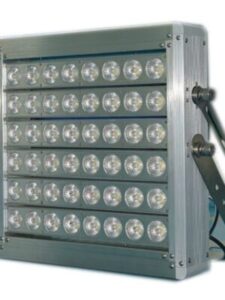
- LED floodlights: perimeter security and sports field applications requiring directed high-output illumination
- LED wall pack lights: building-mounted exterior lighting for loading docks, rear entrances, and perimeters
- LED canopy lights: covered parking structures, fuel canopy stations, and drive-through applications
Do not select wattage based on the metal halide rating alone. The right LED wattage depends on pole height, fixture spacing, and the footcandle level your application requires.
2. Pole Compatibility and Mounting: What Changes During an LED Upgrade
A fixture ordered without confirming tenon size, pole gauge, and arm configuration can require additional hardware that adds cost and time on site.
Affordable Lighting carries light poles in round and square profiles and steel and aluminum construction, along with tenon adapters and bullhorn mounts. Confirm fixture-to-pole compatibility before the order ships.
How Affordable Lighting Approaches LED Outdoor Lighting
Affordable Lighting is a family-founded LED outdoor lighting supply business, established in 1999, operating for over 25 years. All products are tested by an in-house team of skilled professionals before being listed for sale.
Every project receives individual attention, and recommendations are tailored to the specific installation requirements. The “Send Us Your List” service connects you with the team before you place an order.
1. Which Option Is Best For You?
Metal halide is best suited for: Facility operators replacing a single fixture in an existing MH system who need a short-term fix before a full LED retrofit is budgeted.
LED outdoor lights are the right fit for commercial property owners, facility managers, and electrical contractors ready to reduce long-term energy costs and eliminate recurring maintenance cycles across their full outdoor lighting system.
Frequently Asked Questions
Q1. How long does it take for LED outdoor lights to pay for themselves compared to metal halide?
The payback period for LED outdoor lights replacing metal halide typically falls between two and five years, depending on daily operating hours and your local utility rate. After payback, ongoing energy and maintenance savings represent a direct reduction in operating costs for the remaining life of the installation.
Q2. Can I replace my metal halide fixtures with LED without changing the pole?
In many cases, yes, but verify three measurements before ordering: tenon diameter, pole gauge, and arm configuration. If they do not match the new fixture’s requirements, a tenon adapter or bullhorn mount resolves the gap without replacing the full pole.
Q3. What wattage LED fixture replaces a 400-watt metal halide light?
A 400-watt metal halide system draws approximately 455 watts at the system level once ballast losses are included. An LED fixture delivering equivalent output for most commercial parking lot applications typically falls in the 150- to 200-watt range, depending on lumen output, beam angle, and mounting height.
Q4. What is the difference between LED floodlights and LED parking lot lights for a commercial property?
LED parking lot lights distribute light across a wide horizontal plane for even area coverage. LED floodlights direct a concentrated beam at a specific target, making them better suited for security perimeters, building facades, and sports field applications.
Conclusion
Your cost decision is clear. LED outdoor lights deliver lower energy consumption, fewer maintenance cycles, instant-on reliability, and a total cost of ownership that outperforms metal halide on every commercial property metric. The upfront cost is real, and so is the payback.
Confirm the right fixture type, wattage, and pole configuration for your specific installation before you order.
Not sure which LED outdoor lights and poles are right for your project? Send Affordable Lighting your list and get a direct, expert recommendation before you order.
About author

Add comment