

Solar LED Lights vs. Wired LED Lights: Which Works Best for Your Property?
When you search for solar LED lights vs. wired LED lights, you find dozens of opinions, each claiming the definitive answer. Some push solar as the automatic future. Others insist hardwired systems are the only serious commercial option. Neither claim tells the whole story, because the right choice depends on your site, not a general rule.
This article breaks down how solar LED lightingand wired LED lighting work, where it performs best, and what determines the right fit for a parking lot, an industrial building, or a sports field.
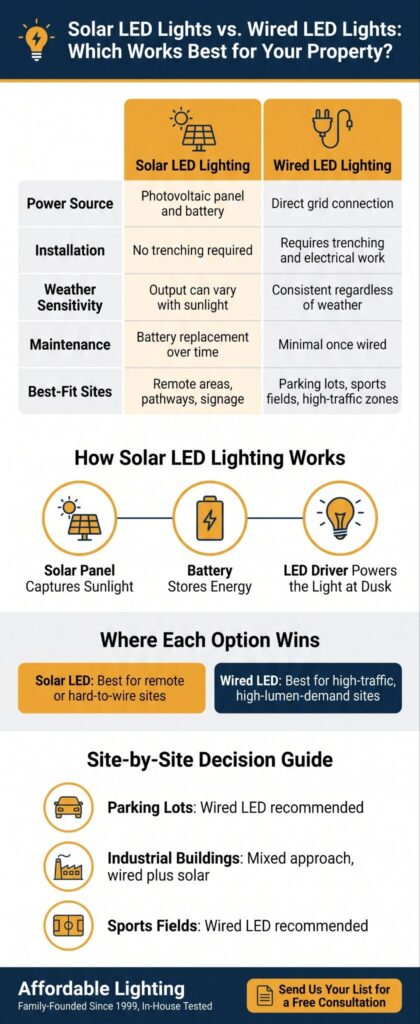
Quick Comparison: Solar LED vs. Wired LED Lighting
Solar LED and wired LED lighting solve the same problem in different ways. The table below shows where they diverge.
| Factor | Solar LED Lighting | Wired LED Lighting |
| Power source | Photovoltaic panel and battery | Direct grid connection |
| Installation | No trenching or wiring required | Requires trenching and electrical work |
| Weather sensitivity | Output can vary with sunlight hours. | Consistent output regardless of weather |
| Maintenance | Battery replacement over time | Minimal once wired correctly |
| Best-fit sites | Remote areas, pathways, signage | Parking lots, sports fields, high-traffic zones |
How Affordable Lighting Approaches Solar vs. Wired LED Selection
Affordable Lighting is a family-founded LED lighting supply business, established in 1999, operating for over 25 years. That history shapes how the company helps buyers choose between solar and wired LED fixtures for a specific project, rather than pushing one option as universally better.
How Solar LED Lighting Works
A solar LED fixture pairs three core components: a photovoltaic panel, a rechargeable battery, and an LED driver with a dusk-to-dawn sensor. During the day, the panel converts sunlight into stored energy. At dusk, the sensor triggers the driver to draw power from the battery and run the LED through the night.
Established federal research from the U.S. Department of Energy shows that LED technology alone can reduce site lighting energy use by up to 40 percent compared with older lighting types.
Pairing that efficiency with solar power can eliminate the need for grid electricity.
Where Solar LED Can Deliver Strong ROI
Solar LED lighting earns back its cost fastest on remote sites, such as property perimeters or lots far from an existing service panel, where new wiring would be expensive or impractical.
Removing that trenching labor often makes solar the more affordable choice over the fixture’s life, even though upfront hardware costs are comparable.
What to Confirm Before Choosing Solar for Your Site
Before selecting solar, confirm the site gets consistent daily sun exposure. Also check the battery capacity against your dusk-to-dawn runtime and verify the panel wattage matches your fixture’s lumen output. A reliable supplier lists these specifications on every product page.
Where Wired LED Lighting Fits Best
Wired LED lighting connects directly to your property’s electrical system, so output does not depend on sunlight, season, or battery age. This makes it a practical choice for high-traffic parking lots, industrial buildings, and sports fields that need consistent, high-lumen output every night, regardless of cloud cover or winter daylight hours.
The U.S. Environmental Protection Agency’s ENERGY STAR program reports that certified LED lighting products use up to 90 percent less energy and last up to 25 times longer than incandescent lighting, part of why wired LED remains strong for properties with reliable grid access.
Wired systems can also support higher-wattage fixtures than many solar setups, which matters for large-area coverage.
A Pacific Northwest National Laboratory field study on area lighting retrofits found that switching from legacy metal halide fixtures to LED systems cut lighting energy use by 69 percent, which illustrates how much efficiency a wired LED upgrade can capture on a high-traffic commercial site.
The trade-off is a higher upfront installation cost tied to trenching and electrical work, plus dependency on the grid for nightly operation.
The Key Differences That Matter
Solar and wired LED lighting trade different advantages for different costs. The right choice comes down to which trade-off fits your site.
Power Source and Installation Trade-Offs
Solar lighting skips trenching and wiring, lowering installation complexity for remote or hard-to-access sites. Wired lighting requires that upfront electrical work, but in exchange it delivers unlimited nightly runtime without relying on stored battery capacity.
Long-Term Cost and Maintenance Trade-Offs
Solar systems avoid ongoing electricity costs but require periodic battery replacement, typically every few years. Wired systems carry a grid electricity cost but need little maintenance once installed correctly, since there is no battery to monitor or replace.
Which Option Is Best for Your Property?
The better system depends on where you are installing it. The answer changes across the three property types that Affordable Lighting serves most often.
Best for Parking Lots, Industrial Buildings, and Sports Fields: A Site-by-Site Decision Framework
Parking lots with grid access and heavy nightly traffic may be better suited to wired LED lighting, since output must stay constant regardless of season.
A U.S. Department of Energy analysis found that LED parking lot fixtures demonstrated an 85 percent reduction in energy usage compared with high-intensity discharge fixtures, reinforcing why wired LED is the default for high-traffic lots.
Industrial buildings often benefit from a mixed approach: wired lighting over loading docks and entrances and solar lighting along perimeter fencing.
Sports fields need high, uniform lumen output for safe play, so wired systems may be better suited to these applications, since battery-based solar output rarely matches the footcandle level a full field requires.
If your project spans more than one environment, the right combination is rarely obvious from a spec sheet alone, which is exactly what Affordable Lighting’s project consultation helps you sort out.
Affordable Lighting’s In-House Testing Standard
Affordable Lighting tests every product in-house before it is listed for sale, whether it is a solar fixture or a wired one. The product specifications provide buyers with information about each fixture’s performance, alongside the manufacturer’s specifications.
Best For Labels
Solar LED lighting can suit property owners who need lighting in spots without easy electrical access, such as remote lot corners, pathways, and signage.
Wired LED lighting suits owners managing high-traffic sites, including parking lots, industrial yards, and sports fields, that need consistent, high-lumen output year-round.
Frequently Asked Questions
Q1. Do solar LED lights work as well as wired LED lights in winter?
Solar LED lights can still work in winter, but shorter daylight hours and cloud cover can reduce battery charge and can shorten nightly runtime. Wired LED lights are not affected by season, since they draw power directly from the grid.
Q2. How long do solar LED light batteries typically last?
Most solar LED light batteries can last several years, depending on climate, usage hours, and battery type. Checking the battery specification before purchase helps you plan replacement costs in advance.
Q3. Is solar LED lighting cheaper than wired LED lighting overall?
Solar LED lighting can cost less over time on sites where trenching would be expensive, since it removes that labor and ongoing electricity use. On sites with easy grid access, wired LED lighting can be more cost-effective due to lower long-term maintenance.
Q4. Can solar and wired LED lights be installed on the same property?
Yes. Many properties use both wired LED lighting for high-traffic areas like parking lots and sports fields and solar LED lighting for remote areas like fence lines or signage where running power is impractical.
Q5. What should I check before ordering solar LED lights for a parking lot?
Confirm the panel wattage, battery capacity, and lumen output match your required footcandle levels and dusk-to-dawn runtime. If you are unsure how to calculate these for your lot size, send your project details to a supplier for review to avoid an underpowered installation.
Making the Right Choice for Your Property
Solar and wired LED lighting both have a clear place in commercial and residential projects, and neither is the universal answer to the solar LED lights vs. wired LED lights question. The right choice depends on your site’s power access, traffic, and lighting requirements, not on which option sounds more modern.
If you are still weighing solar against wired and want to understand how solar LED lighting would work for your parking lot, industrial building, or sports field, send your project details to Affordable Lighting using the Send Us Your List option for a free consultation and a recommendation matched to your site.
About author


Add comment