

Pole Light Kit vs. Buying a Fixture and Pole Separately: Which Saves More
When you shop for residential LED pole lights, every page gives you a different answer. Some say a pole light kit always costs less. Others say separate parts give you more control. Every option claims to be the best, and few explain what the final bill includes.
This article compares both routes so you can decide with confidence. You will see how fit, mounting hardware, and project support change the real cost.
A kit works best when you start from scratch and want a matched fixture and pole. Separate parts work best when you keep an existing pole or need one exact fixture.
Quick Comparison: Pole Light Kit vs. Separate Fixture and Pole
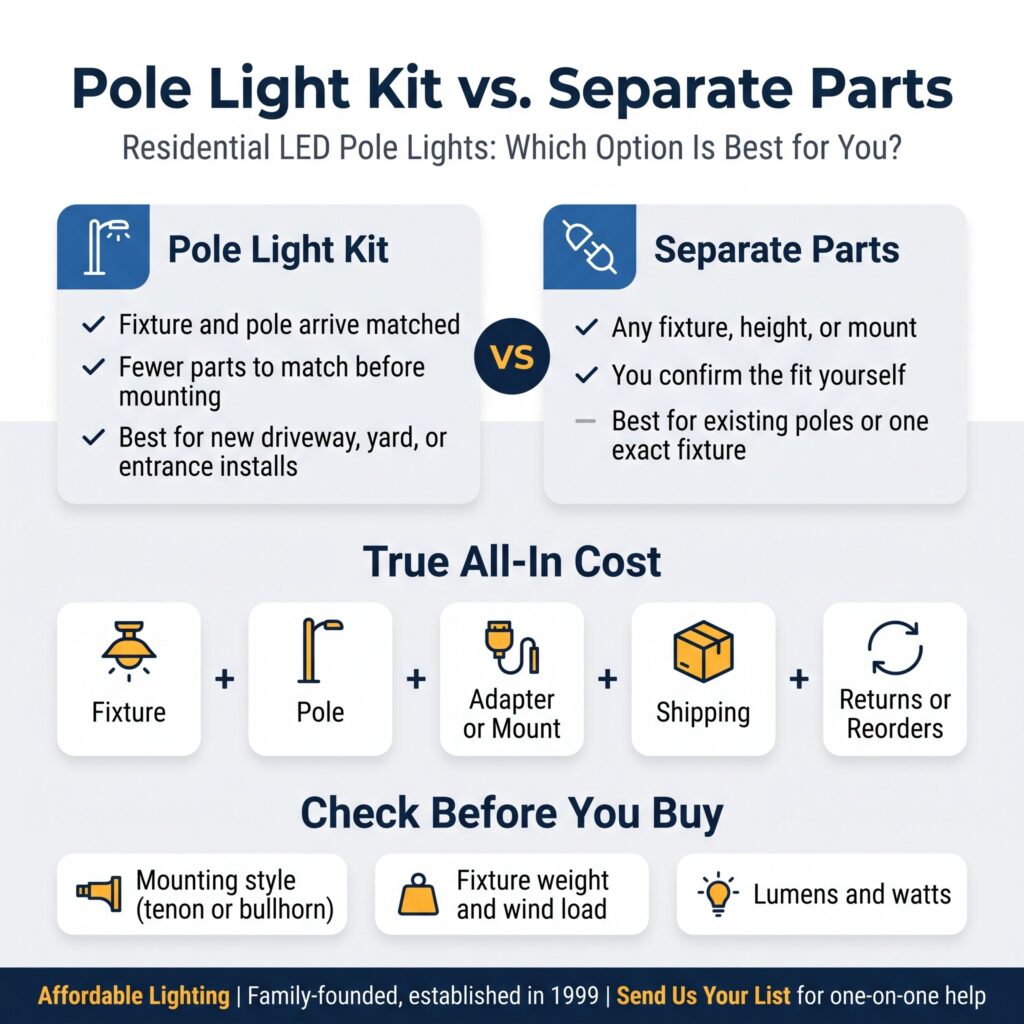
Choosing between a kit and separate parts for residential LED pole lights depends on whether you want matched parts or full control over each piece.
Side-by-Side Criteria
This table shows where each option leads.
| Criterion | Pole light kit | Fixture and pole bought separately |
| Upfront price | Fixture and pole bought together | Each part is priced on its own |
| Fit and compatibility | Selected to work together | You confirm the fit yourself |
| Installation readiness | Fewer parts to match before mounting | An adapter or mount may be needed |
| Flexibility | Set combinations | Any fixture, height, or mount |
| Project support | One-on-one review from Affordable Lighting | One-on-one review from Affordable Lighting |
How Affordable Lighting Approaches Pole Light Kits
For residential LED pole lights on a new installation, a pole light kit can lower the total cost because the fixture and pole arrive matched. You avoid a separate adapter, a returned pole, or a second order to fix a fit problem. Separate parts win only when you already own one of the pieces.
1. Pre-Matched Fixture and Pole Fit
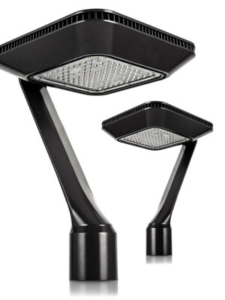
Most buyers pick a fixture first and look for a pole second. That order creates a frequent problem: the pole top does not accept the fixture’s mounting style, such as a tenon or a bullhorn arm. A kit simplifies that step because it pairs the fixture and pole for you.
Wind load adds a second fit check. One U.S. Department of Energy exterior lighting specification (Section 16521) requires pole-mounted luminaires to conform to the AASHTO structural support specifications and caps the effective projected area (EPA) of the luminaire, including its arm and brackets.
The same principle applies when choosing a pole because the fixture, arm, and mount contribute to the overall wind load and weight.
Affordable Lighting is a family-founded LED lighting supply business, established in 1999.
2. Checking Fixture Efficiency
Do not rely on a label alone. The ENERGY STAR list of eligible commercial fixture types excludes outdoor street and area lighting, such as wall packs, garage lighting, and canopy lighting, from earning the ENERGY STAR label.
A pole-top area light may therefore carry no ENERGY STAR mark. Use another yardstick instead.
The U.S. Department of Energy‘s FEMP-designated parking lot lighting guidance provides an efficacy benchmark for qualifying outdoor pole- and arm-mounted area luminaires. Compare each fixture’s light output in lumens with its power consumption in watts.
3. One-on-One Project Review Before You Buy
Affordable Lighting sells through an online cart, yet it prefers one-on-one communication. If you are unsure which products you need, the “Send Us Your List” option lets you submit your project details for guidance. Write down the fixture type, the pole height you want, and the mounting style before you send it.
Where a Kit Does Not Fit
A kit is not the answer to every property. If you already own a pole, you need only a fixture. If you want one exact fixture that no kit includes, you will buy the parts separately. Affordable Lighting’s range includes poles, fixtures, tenon adapters, and bullhorn mounts, so you can still build that order in one place.
- What Buying a Fixture and Pole Separately Involves
Buying residential LED pole lights as separate parts gives you the widest choice, and it also gives you the full job of checking compatibility.
- How the Separate Route Works
You select the fixture for its light output and style. You select the pole for its height, material, and shape, whether steel or aluminum, round or square.
You must confirm that the fixture’s mounting style, weight, and wind load match the pole. Highway lighting specifications address these structural requirements. Each part carries its own price, so you add up the listings yourself. An adapter or mount often becomes a third purchase.
The Key Differences That Matter
Two differences decide most purchases of residential LED pole lights: how much choice you need and what the full order really costs.
1. Separate Parts Offer More Choice; You Must Check Compatibility
Separate parts let you choose any fixture, any height, and any mount. That freedom is real. However, every free choice becomes a compatibility check that you must complete before you order. A kit trades some of that choice for a pairing the kit has already made.
2. True All-In Cost: Fixture, Pole, Adapter or Mount, and Shipping
Comparing only the fixture price and the pole price understates what separate parts cost. Add every line below before you compare options.
- Fixture price
- Pole price
- Tenon adapter or bullhorn mount, if the pole top and fixture do not match
- Shipping for each item
- The cost of returning or reordering a part that does not fit
A kit shortens this list because the kit pairs the parts in advance. Compare the full total for both routes, not the two headline prices. Prices change by product, so the totals will differ for your project.
Which Option Is Best for You?
Matching your situation to the right label makes buying residential LED pole lights simpler.
Choose a Pole Light Kit If
- You are adding new pole lighting to a driveway, yard, or entrance.
- You want a pre-matched fixture and pole.
- You want one-on-one guidance before you order.
Choose Separate Parts If
- You keep an existing pole or need one specific fixture, height, or mount.
- You want to compare several fixture options before you choose.
- You are ready to check compatibility yourself.
Affordable Lighting backs both routes with a stated quality step: all products are tested by an in-house team of skilled professionals before being listed for sale.
Frequently Asked Questions
Q1. Is a pole light kit cheaper than buying a fixture and pole separately?
In many new installations, a pole light kit can lower the total cost. The fixture and pole arrive matched, so you avoid a separate adapter, a return, or a second order to fix a fit problem. If you already own a pole, buying only a fixture usually costs less than a kit.
Q2. Can I use any LED fixture on any light pole?
No. The fixture’s mounting style, weight, and wind load must match the pole. A tenon fixture needs a pole top that accepts a tenon, and some poles need a bullhorn mount or an adapter.
Q3. What adapters or mounts might I need with a separate fixture?
You may need a tenon adapter or a bullhorn mount. The right piece depends on the pole top and the fixture. Send your list to Affordable Lighting for a one-on-one check.
Q4. How do I get help choosing the right kit?
Use the “Send Us Your List” option. List the fixture type, the pole height, and where you plan to mount the light. Affordable Lighting reviews the list and recommends a match.
Conclusion
Your next step with residential LED pole lights is to compare a written parts list against a kit before you buy anything separately.
Write down the fixture, the pole height, and the mounting style you want. If a kit covers that list, it removes the fit check. If it does not, you have a clear parts list for a separate order.
Send your list to Affordable Lighting for one-on-one help matching your fixture and pole.
About author

Add comment